Showing posts with label kennel. Show all posts

Wednesday, March 13, 2013

How to Safely Crate/Kennel Train a Dog or Puppy


I’m working with an Alberta Bulldog Rescue foster dog right now. His name is Manny and he has a few behavior problems that need to be addressed. The first and foremost is safe containment. Manny has a really hard time travelling in a vehicle and also has an upcoming knee surgery where he’ll have to kenneled for long periods of time.
 
(I have lots of other reasons for crate training dogs which can be found here).


So the question is: how do I get an adult dog with impulse control concerns, barrier aggression and handling sensitivity to go into his crate and love it?

Here are our steps:

1. A very large wire crate is put into Manny’s living area so he can go in and out as he pleases.

2. I throw a treat into the kennel and Manny follows it cautiously. I actually had to back up anyway from the kennel before he would go in for the treat.

3. We repeat the throwing cookie a number of times. Manny is getting braver and is staying in there a bit longer. Anytime he stays in the kennel I toss in additional treats.

4. Manny’s foster mom had success practicing with him over the last week. He goes in for up to 5 minutes at a time on his own. At this point we’re still leaving his kennel door open. Manny can also be found sitting in there on his own without treats.

5. Now we’re going to add a cue word. I say “Go to Bed” and wait for the dog to move into his crate on his own. He gets the treat once he’s inside.

6. Once Manny figures out what Go to Bed means then we can start asking him to do that first and receive a cookie once he’s already in there.

7. It’s time to add the closing of the kennel door. For most dogs you’d close the door, deliver a few treats and then open it again. The length of time should be gradually increased. We also want to teach Manny there’s a command for when he’s allowed to come out so we would open the door, use our legs to block the entry (while still rewarding) and then give a cue work like “All Done” and move out of the way.


Eventually we’ll be able to have him stay in there for longer time periods and wait patiently to be released to come out. Crate training can take a long time depending on the dog. It’s important to give yourself at least a few weeks and in the case of dogs who suffer from separation anxiety a lot longer (up to a year).

I highly recommend using an interactive feeding toy like a stuffed kong to help get your dog comfortable in the crate. Feeding all meals with a stuffed kong (or similar toy) will give your dog daily practice. Very large bones or antlers can also be used but as always use common sense and if needed supervise your dog so he/she doesn’t choke.

Remember if your dog has severe anxiety or any signs of aggression you should work on these training solutions with a Behaviourist (someone who has a Master’s degree or PhD in animal behavior) or Certified Professional Dog Trainer (CPDT designation).  

Wednesday, August 22, 2012

Trouble Shooting: House Training

Whether you have a young puppy or an adult dog that uses the indoors as a bathroom it’s generally the same training techniques to solve this problem. Yet sometimes house training isn’t straight forward at all.
Please keep in mind that sudden onset of house soiling in a previously trained dog means a visit to the vet. It can also be a good idea to get an untrained dog/puppy checked out if house training isn’t progressing smoothly.
Now here are a few scenarios that I come across with my foster dogs and my clients.
#1 Fido is urinating or defecating in his kennel overnight.
This is a common occurrence in puppies in particular (especially those small breeds). There are a few reasons for this including adopting from a kennel environment where your dog learned to soil him/herself, inability to hold his/her bladder for long periods of time, etc.
Now what to do about it? Obviously we don’t want our dogs to learn to be dirty so here’s a few solutions that have worked over the years:
-          Remove bedding from the kennel (if your dog soils when there is not bedding then try another option and give him/her the bedding back).
-          Put your pup in a large kennel and create a separate bed and bathroom area (pee pads or house training pad can be used). I usually set up an Extra Large Kennel with a small kennel inside for sleeping area.
-          Set your alarm and give your pup bathroom breaks overnight. Start with every 4 hours. Make these business trips so to speak. No playing or long cuddle sessions. Just take him/her outside, give a cue to indicate it’s time to eliminate. Tell him/her they are good dog and then back to bed. Gradually increase the time between overnight bathroom breaks.

#2 Fido sneaks off to eliminate in the house unseen (even after being walked!)
This is another common problem. Sometimes when a dog is exercised it will stimulate his/her digestive system and they need to go to the bathroom. Dogs can be nervous (or over excited) to go to the bathroom while on a walk so take a short detour into the backyard where it is quiet after walking.
In the house you may need to settle up an exercise pen or blocked off section where you can supervise your dog. Barricade any spots where your dog routinely goes to the bathroom.
Set your dog up on a bathroom schedule where he/she goes out regularly and praise for going outside. Gradually increase the time in between bathroom breaks. If your dog isn’t timid then you can tell interrupt them if they start to go inside and head out (don’t be angry or intimidating as it can make the problem worse).
Another option would be to tether your dog to you. This can be difficult to live and you’ll need a long leash (over 6 feet). It will allow you to keep your eyes on Fido.
Looking for more house training help? Check out Way to Go by Patricia McConnell.

Friday, November 5, 2010

5 Reasons Kennel Training is Essential

While out working with clients I often get the question "Do you kennel train your dogs?". Well the answer is of course and for these reasons. 


1. In case of medical emergency. My dog Tank recently had knee surgery and has been on kennel rest for 3 months. I can't image trying to get him comfortable with that if he hadn't already been use to staying in a kennel

2. Travel. When on the road I need a place where my dogs can stay comfortably. This means we are more likely to be accepted at friends' homes and hotels. My dogs also get to take their "room" with them and therefore ease some anxiety.

3. Dog shows. Essential for anyone competing in dog sports. My dogs need to be able to hang out quietly in their kennel so I can walk courses, grab lunch and run one dog at a time. 

4. Problem prevention. My dogs are kenneled when I go out. This keeps them from learning/practicing destructive behaviour such as eating garbage or more valuable objects in my home. This especially important with a young dog. They simply don't get the opportunity to learn bad behaviour this way.

5. Practicality. I have 3, sometimes 4 dogs in my home. Kenneling is an excellent way of feeding with ease, giving rest time to my exuberant dogs and giving guests who might not enjoy dogs a chance to visit (important when my infant nephew comes over).

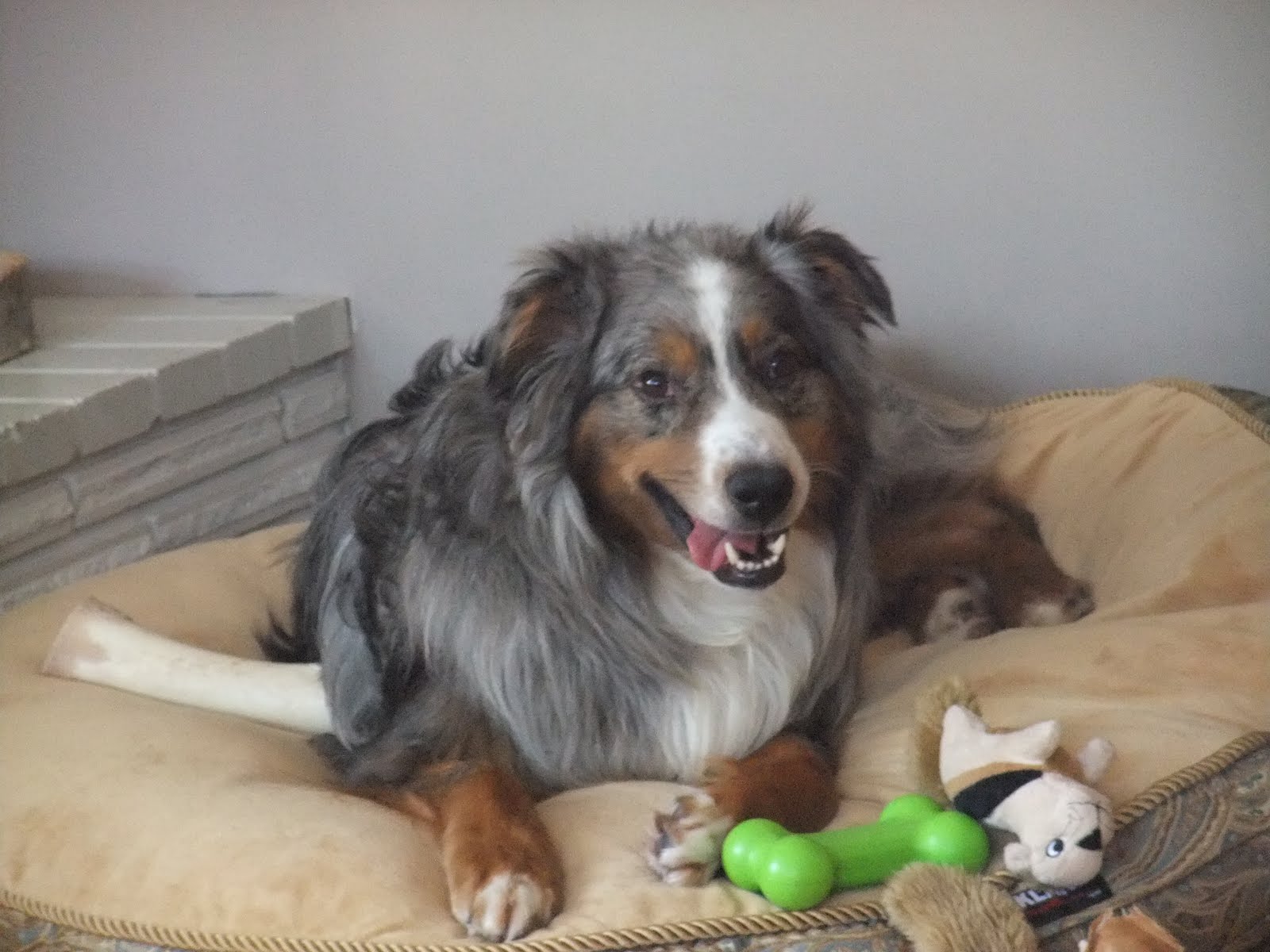
There are so many reasons to kennel train. I highly recommend it and although my dogs spend very little time in their kennels on a day to day basis it's a skill that comes in handy. Even as I write this Tank is lying in his kennel enjoying a bone with the door open. He often chooses to hang out in there.

Tuesday, September 28, 2010

The True Value of Obedience Skills


I've always thought of obedience training as crucial to having a polite, well mannered family dog. As a dog sports competitor obedience is also a set of skills that dogs need to master to a very specific criteria. This month however, obedience skills had another use in my home.

Tank, my 4 year old Australian Shepherd has been suffering from a slight tear in his cruciate ligament. After months of osteopathy and kennel rest it became apparent that he needed surgery to recovery from this injury. After several weeks of preparation (DAP, setting up "stations" around the house for him and getting rid of some excess weight) Tank was ready for his big day. He came through the surgery without cause for concern but we still had an arduous journey ahead of us.

Our wonderful vet, Dr.Barlow from Okotoks Animal Clinic told us bluntly from that start that he was responsible for 30% of the success but the other 70% comes from rest, physio and proper management of his recovery. Tank began 3 months of kennel rest with limited exercise and no contact with our 2 other dogs.

Limited exercise meant that Tank needed to spend his days in an exercise pen or kennel. Thanks to kennel training throughout his life he was able to adjust to this without pause. He has always associated his kennel and pen with a nice bed, good toys and wonderful treats. It also meant that on Tank's short 3 to 5 minute walks he needed to be under control. Of course a formal heel comes into play here. This high energy, happy go lucky dog was no longer getting off leash time so he was a bundle of excitement on walks. We used the formal heel to keep focus on the handler, ignore distractions such as other dogs, squirrels and rabbits as well as to keep him from putting excess pressure on his healing knee.

The work didn't stop there. Tank gets regular cuddle sessions throughout the day to ease his mind and of course keep him happy. The dog can't get enough love to save his life! So Tank began to get "special" treatment. He was allowed to have one on one time on the couch or the bed while I enjoyed a book or tv show. This meant that Tank needed a stay so that he wouldn't jump off the furniture and injure himself. This stay included distractions such as family members coming home, doorbells and strange noises. Luckily Tank has long ago mastered the stay and could safely hang out on the couch or bed without cause for concern.

Never doubt the benefits of obedience training. You never know when you will need these skills in real life. Tank's handle-ability also allowed for x-rays to be taken without him having to be sedated. There are numerous uses for obedience and I can't imagine going through this surgery and recovery without these skills.