Monday, January 10, 2011

The New Foster Kid: Bailey

Miss Bailey arrived at my home yesterday evening and has started to settle in. She is a 7 year old Yorkie mix and has had a hard life. Bailey is reportedly from a Puppy Mill and after being retired as a breeding dog she has been unable to find a suitable home. She has been placed twice and neither home worked out. Her first adoptive owner moved after having her for a few short years while her second home had a small child and a cat that were unsuitable for her shy personality. Her second family decided to get help as she clearly needed a new family. 


So Bailey has joined my pack and I for some rehabilitation before moving on to her forever home. Her next adopters will be carefully screened to make sure they will be a permanent and exceptional home for this tiny little girl. 


Bailey makes a great case study for anyone who owns a shy, timid dog. Her story is sadly altogether common. She missed out on early socialization as a puppy when the people responsible for her kept her locked in a cage. She is therefore terrified of most things: kids, strangers, loud noises and lacks key social skills that would allow her to interact comfortably with other dogs (rather than avoiding them). 

The Plan: give Bailey a much needed confidence boost and help her learn new skills that will allow her to be successful with her next family.

How are we going to do that? 

The first step is to allow Bailey to settle in and adjust to the new environment. This might take some time, but once she realizes she's safe and my dogs won't bother her, life will get a little easier for her. I help new dogs settle in by setting up a regular daily schedule so she can expect when meals will be, when exercise will happen, when nap time/bed time are and other regular activities. Structure is crucial for anxiety ridden dogs (and good for all dogs). Setting up a structure will also allow us to house train Bailey.

We will also consider a DAP collar and a Thunder shirt for Bailey depending on how she does over the first week. She will also get a vet check up to make sure she has no medical issues that could be affecting her mental state. 

Step number two will involve some confidence building. We will begin to work on "hand targeting" which will encourage Bailey to come to my partner and I. We'll be using cheese as a reinforcer for this and a clicker to mark the behaviour. Video to follow

Bailey will also begin attending a group training class at Where's Your Sit. My partner Douglas has been kind enough to volunteer his time as her handler. We selected a class with dogs all under 20lbs in size. This was done on purpose. Bailey will be introduced to larger dogs but only ones who have already attended obedience classes so that they don't scare her further. My own pack includes 2 medium size dogs that she has already met. 

 The goal of a group class for her will not be obedience skills. If we expected her to learn sit, down, stay, heel , etc. we would be disappointed. Bailey is going to work on being in the room while the other dogs learn. She will get to meet people and dogs in the class when she is ready. The new environment will be her challenge in this case. Once she's comfortable we can practice the skills she's learning at home like the hand target. She will not be expected to learn anything new in class. When she's more confident we can explore classes for training but this time it's about socialization to a new environment, people and dogs.

Bailey's progress will be posted on the blog and our website. Feel free to ask questions! Also note that we are interviewing potential adopters for Bailey. She will be available to the right new home once she has finished the beginning stage of confidence boosting. Her new family will receive both group and private training lessons through Where's Your Sit as part of her adoption package.

Bailey's Page


Saturday, January 1, 2011

One of my Favourite Training Tools

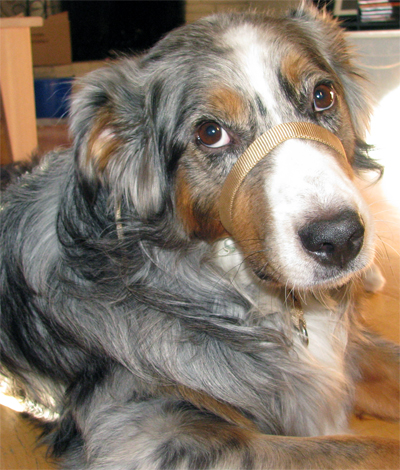
Since Loose Leash Walking seems to be a major struggle for most dog owners I wanted to take some time and introduce one of my favourite dog walking products: the Gentle Leader. It's fairly well known but I still come across quite a number of frustrated owners who haven't heard of it. 


The Gentle Leader works in a similar way to a horse halter/head collar. It fits over the mouth and snaps behind the ears. Dogs can eat, drink and play with it on. It does get mistaken for a muzzle sometimes but don't be fooled; dogs can definitely still bite with it on! 


The purpose of the Gentle Leader is to take away the dog's ability to pull. Although no training tool will solve pulling all by itself this one comes the closest. In my opinion it works better than harnesses, choke collars, shock collars or prong collars and is of course humane. I find it works best for medium to large breed dogs such as Australian Shepherds, Labradors, Malamutes, etc. For the smaller dogs I generally recommend a Sensation Harness or an Easy Walk Harness but you can use Gentle Leaders on the small ones too. 

The down side to head collars in general is that some dogs simply don't like to wear them (picture your puppy at 8 weeks with his/her first collar and they flail around). You need to start off slow by putting it on, feeding a few treats and then taking it off right away. I recommend doing this a few times and leaving it on just a bit longer each time. After a few days try a walk.

Another thing to keep in mind is that if you have previously used a type of correction collar: martingale, prong or choke chain then you need to be very careful about not "correcting" with the Gentle Leader. You don't want to throw your dog's spine out of wack and it's not meant to be jerked about in a harmful manner. On the bright side if you have damaged your dog's throat by using a correction collar than a Gentle Leader will be safer and more comfortable for your dog to wear. 

I've used a Gentle Leader for 3 out of 4 of my own dogs: Russ, Tank and Marco while training them to walk on leash. Tank still likes to wear his. Make sure to combine a Gentle Leader with training (using treats to reinforce heel position, direction changes to keep your dog interested and not moving forward when he/she pulls). 


Where's Your Sit runs a special program just for Loose Leash Walking for those of you in the Calgary area struggling with this issue on your otherwise well behaved dog.

Tuesday, December 21, 2010

How To Use Your "Leave It" Cue

So many dog owners are now choosing to attend a basic dog training class. They learn skills like sit, down, stay, heel, leave it and recall. Or at least they sort of learn these skills depending on how much they practice. What I have noticed is that even though dogs and their families are learning these cues they aren't sure how or when to use them. 

Let's discuss the important Leave It or Mine cue. This means that you've asked your dog to not touch and back off an object such as a treat, toy or person. Many dogs get really good at this as a party trick. I can easily line up treats on my dogs' legs as they look away waiting for a chance to earn one. However Leave It as many real world applications that could help you out. 


Here's some examples:

Situation #1
I'm walking my dog down the street and we have to pass another owner and dog. My dog starts to get excited, pull and even bark! I can ask my dog to leave it, focus on me and then heel on or leave it, focus on me and do a sit stay as they pass. So much better than yelling at my dog, yanking on the leash or allowing him to pull me over. 

Situation #2
I'm cooking some hamburgers for dinner and one falls off the plate! All four of my dogs do a mad scramble to grab these delectable entry. A good leave it means they all back off and I get my burger back.

Situation #3
My young puppy has grabbed a boot and is playing keep away. He thinks he's being so cute with it. I know that if I chase him he'll never give it up. So instead I ask him to leave it and then call him to me. The boot is left behind, forgotten until I put it away where he can't get it. 

Situation #4
I'm at the dog park and of course one of my dogs finds a dead duck sitting near the river. Well I definitely don't want to grab that out of his mouth nor do I want one of my other dogs to dart in and start a tug of war. I ask them to leave it and the finder dog promptly drops the duck and all dogs follow me away from it. I didn't even get my hands dirty and no one ate it. 

Situation #5
It's winter and one of the dogs is in the yard eating poop... yes it happens and the jury is still out why they do it. I don't care why right now; I want him to stop it. So I open the door yell out leave it and he drops the yucky stuff. 

And there's more you can do with leave it! It's one handy cue word. Leave it can be applied to anything you don't want your dogs to have (objects, people, dogs, garbage, rocks, etc). It can also stop dog fights in the home... for example if one of your dogs is guarding a toy or bone and it is about to trigger a battle. I can easily claim the object by saying leave it and removing it. It saves a lot of trouble! 

Remember that if you have a dog that guards things like bones, food or toys you will need to contact a professional trainer or behaviourist to help you. It's very important to understand dog body language when dealing a potentially threatened pet. We don't want to push our dogs to guard or bite us. There's many ways to use desensitization to change that situation around over time. 

Contact Where's Your Sit if you want more information on leave it or resource guarding issues. We would be more than happy to help!

Friday, December 17, 2010

Why Dogs Develop Aggression?

Aggression can mean a lot of different things. Most owners are describing behaviours that they feel are threatening when referring to aggression. Commonly this can be biting where there's an injury, biting where there's no injuring, growling, barking, lunging, air snapping, etc. 

Sometimes the reason for "aggressive" behaviour is clear and other times it's not. For many dogs they start with low level behaviour such as growling and progress to more serious threats when they realize that it works. Other dogs may suddenly develop "aggression". 

The first step would be to rule out medical issues. An animal in pain will not act like they usually do and might respond to touch in a dramatic fashion. When my dog Tank had a knee injury he began to shown aggressive behaviour when dogs came near that part of his body. He would snarl, growl and even air snap. This was unusual for him and a clear sign that something was wrong. 

Another cause for aggression is often fear. This can not be understated. Dogs who are scared will run or fight. We humans unwittingly trap our dogs with leashes, walls, kennels, etc and can trigger a bite when a dog really just wants to avoid. 

Dogs can be fearful of anything! Common issues include fear of strangers, kids, loss of a valuable resource (ball, sock, food) and of course other dogs. If we treat aggression (fear) with physical violence or force then we are often pushing the dog to escalate his/her own aggression. A better approach would be to use slow desensitization to the source of the fear so our dogs learn to deal with it. 

Aggression is one of those behaviours that needs to be treated with care. It's imperative that you seek help from a professional trainer or behaviourist and veterinarian. For more information please contact Where's Your Sit or the Association of Pet Dog Trainers (APDT).

Tuesday, December 7, 2010

Off Leash Awareness

I have 4 dogs so when we hit the off leash park it would be easy to lose track of them all... however I taught all of my dogs to watch for me too. This means that as we walk they have learned to naturally check where I am and stay close (close has a different meaning for each of the dogs... Russ thinks it means within shouting distance while the others hang out a bit more in eye sight). 


Teaching your dog to check in is easy! Once you've mastered a good recall and are ready to be off leash safely you can begin working on this one. Bring some great treats with you and randomly reward your dog for coming back to you on his/her own (you didn't call but they just came back) or making eye contact with you as you walk along. 
Over time your dog will begin to check in because it's been reinforced. This means that your dog has decided that you have value and he/she might be rewarded for paying attention rather than being lost in the dog heaven that is the off leash park. 

This is particularly important for independent breeds such as your terriers, northern breeds and many rescue dogs. While I don't continue to feed my dogs forever at the park I still continue the practice once in awhile. It's important (especially with a large group) to have dogs that care about your location. 

I have found this skill to be extremely useful when we're hiking out in the mountains or walking in a very distracting area. The check in is easy to teach and a must have for off leash walking!