Showing posts with label stay. Show all posts

Wednesday, March 13, 2013

How to Safely Crate/Kennel Train a Dog or Puppy


I’m working with an Alberta Bulldog Rescue foster dog right now. His name is Manny and he has a few behavior problems that need to be addressed. The first and foremost is safe containment. Manny has a really hard time travelling in a vehicle and also has an upcoming knee surgery where he’ll have to kenneled for long periods of time.
 
(I have lots of other reasons for crate training dogs which can be found here).


So the question is: how do I get an adult dog with impulse control concerns, barrier aggression and handling sensitivity to go into his crate and love it?

Here are our steps:

1. A very large wire crate is put into Manny’s living area so he can go in and out as he pleases.

2. I throw a treat into the kennel and Manny follows it cautiously. I actually had to back up anyway from the kennel before he would go in for the treat.

3. We repeat the throwing cookie a number of times. Manny is getting braver and is staying in there a bit longer. Anytime he stays in the kennel I toss in additional treats.

4. Manny’s foster mom had success practicing with him over the last week. He goes in for up to 5 minutes at a time on his own. At this point we’re still leaving his kennel door open. Manny can also be found sitting in there on his own without treats.

5. Now we’re going to add a cue word. I say “Go to Bed” and wait for the dog to move into his crate on his own. He gets the treat once he’s inside.

6. Once Manny figures out what Go to Bed means then we can start asking him to do that first and receive a cookie once he’s already in there.

7. It’s time to add the closing of the kennel door. For most dogs you’d close the door, deliver a few treats and then open it again. The length of time should be gradually increased. We also want to teach Manny there’s a command for when he’s allowed to come out so we would open the door, use our legs to block the entry (while still rewarding) and then give a cue work like “All Done” and move out of the way.


Eventually we’ll be able to have him stay in there for longer time periods and wait patiently to be released to come out. Crate training can take a long time depending on the dog. It’s important to give yourself at least a few weeks and in the case of dogs who suffer from separation anxiety a lot longer (up to a year).

I highly recommend using an interactive feeding toy like a stuffed kong to help get your dog comfortable in the crate. Feeding all meals with a stuffed kong (or similar toy) will give your dog daily practice. Very large bones or antlers can also be used but as always use common sense and if needed supervise your dog so he/she doesn’t choke.

Remember if your dog has severe anxiety or any signs of aggression you should work on these training solutions with a Behaviourist (someone who has a Master’s degree or PhD in animal behavior) or Certified Professional Dog Trainer (CPDT designation).  

Thursday, September 8, 2011

How Obedience Skills Are Used During Everyday Walks...


Last night I took the crew out for a run around 9pm. We chose a long stretch of grass that allows the dogs to really run and play. The grass is directly beside a road that sees moderate traffic although it was late at night. Our neighbourhood also includes rabbits, cats and the occassional coyote. 

Here's where obedience skills made our walk safe and fun. We saw a cat right after leaving the front door. A simple "watch" cue told my dogs that they should be focused on me instead. We used our loose leash walking skills to make it over to the grass and as a result I wasn't pulled or hauled around. 

Before taking the dogs off leash they were asked for a sit stay. This gives me to do a once over of the area before giving them freedom. It also gives me a chance to practice sit stay (with a real life reward of play for completing the task). 

Once off leash we needed to use "recall" aka "come" a few times when the Aussies went too far. Remember it's dark out so I wanted to make sure I could always see them. They also discovered various pieces of garbage that I didn't need to touch since they all know "leave it" means forever. 

Occassionally when I saw headlights coming it was time for everyone to offer a down stay. This keeps my dogs safely near me and away from traffic. If I had had a beginner dog with me it would have been the perfect chance to practice leash on (and then showing the dog that they can be unleashed again once the car is past which makes putting on the leash a non-issue).  My dogs are taught to hold stay until I release them verbally with an "all done".

The entire walk took about 30-40 minutes. They practiced almost all their basic obedience commands. We didn't use any additional reinforcers (aka food, toys, etc) because I had the best reward available (running free and playing with each other). Remember that obedience is a way of life and not just a class you take when your dog is young. Practice all the time and incorporate it into any activity you do with your dog. Make playing "obedience" the best game and you'll have a dog that can listen anywhere.

Wednesday, May 18, 2011

The Importance of Motivation

Last night my Adventure Dog class got to see how much MOTIVATION matters in dog training (well really in training anyone including people). I'd love to say that this one type of treat works for every dog in every situation but of course motivation is based on individual preferance, environmental context and of course other factors such as whether your dog is full, tired, thirsty, etc.

When working with your dog try to have a few different types of reinforcers with you. I generally bring some kibble, some higher value treats (Zuke's Minis, Rollover, Dried Liver, Drive Tripe), a ball (Chuck It ball works great), tug toy (Skinneezz work great too especially the rabbit for some reason) and of course my own happy energy level. It's also a good idea to make water available as a thirsty dog really isn't too interested in much else at that point. 

Using the right reinforcer can change your entire training session. It can make the difference between a distracted dog that won't listen and a star student. Make reinforcement random so your dog doesn't get bored (or worse expectant) and change it up.

You can make yourself the reward by teaching your dog hand targets, tricks that he/she loves to preform, praise, petting, running with your pup and more. Having a good attitude and energy level will keep your dog happily working for you. Sometimes patience is hard to find and that's when I would end a training session.

Keep training sessions short with lots of breaks for play and running. This keeps your dog interested and wanting to work. If I do a down stay for 3 minutes and then reward my dog he's going to want to do it again even if it's sometimes boring like a down stay BUT we'll generally do something else first to keep the energy and enthusiasm up. This will allow you to train anywhere and without food and toys once your dog gets it.

I worked with aussies Tank and Marco during an off leash walk last night surronded by other dogs. We practiced 1 down stay, 1 sit stay, 1 off leash heeling (just Marco), 2 left finishes and 1 front. All for the chance to run around with me and jump in the air for hand targets. I kept it fun and they were attentive as a result. They were able to do this surronded by a million fun things like dogs, people, smelling, squirrels and it didn't matter because the training session was fun not arduous.

Friday, February 11, 2011

Sit For Greeting

Have a dog that jumps up on everyone he/she meets? Learn how to teach a sit for greeting.


The first thing you need to ask yourself is: has my dog been reinforced for jumping up? Do you pat your dog when he/she jumps up? Do other people? Do you push your dog off of you and reprimand? Have you used your knees or legs to kick him/her? Have other people?

What you need to know about reinforcement is that good or bad reinforcement can encourage a behaviour. So it doesn't matter whether I'm petting my dog for jumping up or pushing him/her off of me. My dog is still being reinforced for jumping.  Makes things harder doesn't it?

Alright here's a few steps to get you on the right track and remember practice makes perfect!

Step #1 - teach your dog to sit on voice command or hand signal but without touching your dog. It's crucial that you have this basic obedience command down pat.

Step #2 - begin to practice sit around more and more distractions. Ask for sit and then as soon as that butt hits the floor reward. Practice this at doorways, on walks, in the park, around friends, etc.

Step #3 - when you come home from being out don't make eye contact or speak to your dog until he/she sits (without a command). As soon as your best friend is sitting then shower with praise, toy, pets, food, etc. If he/she jumps go back to ignoring. For those really high energy dogs keep your vocal praise low key so you don't trigger the jumping up again from excitement.

Step #4 - start to add friends/family to training session. Have your dog take a sit position before the person even becomes visible. Reinforce continually to keep your dog sitting (meaning giving a kibble or treat every few seconds). As long as the dog is sitting the person can come closer. If the dog gets up then the person immediately needs to back up and leave.  You then start again. Eventually the person will be standing beside the dog while the dog is sitting. You can then have your friend/family member give the dog a treat for sitting. Practice until this is easy.

Step #5 - slowly fade out the food reward until you can do this without food. Meaning over the course of several training sessions use less and less food. If the dog regresses then go back to the basics.

Step #6 - begin to ask your dog for a sit whenever a person comes into view. Over time your dog will learn that he/she is expected to sit when greeting a human. Once your dog is reliable on leash then move to practicing off leash.

If your dog does jump on someone unexpected have the person become a "tree" and if they need to they can turn around so their back is to the dog. This works great for kids. 

Tuesday, December 21, 2010

How To Use Your "Leave It" Cue

So many dog owners are now choosing to attend a basic dog training class. They learn skills like sit, down, stay, heel, leave it and recall. Or at least they sort of learn these skills depending on how much they practice. What I have noticed is that even though dogs and their families are learning these cues they aren't sure how or when to use them. 

Let's discuss the important Leave It or Mine cue. This means that you've asked your dog to not touch and back off an object such as a treat, toy or person. Many dogs get really good at this as a party trick. I can easily line up treats on my dogs' legs as they look away waiting for a chance to earn one. However Leave It as many real world applications that could help you out. 


Here's some examples:

Situation #1
I'm walking my dog down the street and we have to pass another owner and dog. My dog starts to get excited, pull and even bark! I can ask my dog to leave it, focus on me and then heel on or leave it, focus on me and do a sit stay as they pass. So much better than yelling at my dog, yanking on the leash or allowing him to pull me over. 

Situation #2
I'm cooking some hamburgers for dinner and one falls off the plate! All four of my dogs do a mad scramble to grab these delectable entry. A good leave it means they all back off and I get my burger back.

Situation #3
My young puppy has grabbed a boot and is playing keep away. He thinks he's being so cute with it. I know that if I chase him he'll never give it up. So instead I ask him to leave it and then call him to me. The boot is left behind, forgotten until I put it away where he can't get it. 

Situation #4
I'm at the dog park and of course one of my dogs finds a dead duck sitting near the river. Well I definitely don't want to grab that out of his mouth nor do I want one of my other dogs to dart in and start a tug of war. I ask them to leave it and the finder dog promptly drops the duck and all dogs follow me away from it. I didn't even get my hands dirty and no one ate it. 

Situation #5
It's winter and one of the dogs is in the yard eating poop... yes it happens and the jury is still out why they do it. I don't care why right now; I want him to stop it. So I open the door yell out leave it and he drops the yucky stuff. 

And there's more you can do with leave it! It's one handy cue word. Leave it can be applied to anything you don't want your dogs to have (objects, people, dogs, garbage, rocks, etc). It can also stop dog fights in the home... for example if one of your dogs is guarding a toy or bone and it is about to trigger a battle. I can easily claim the object by saying leave it and removing it. It saves a lot of trouble! 

Remember that if you have a dog that guards things like bones, food or toys you will need to contact a professional trainer or behaviourist to help you. It's very important to understand dog body language when dealing a potentially threatened pet. We don't want to push our dogs to guard or bite us. There's many ways to use desensitization to change that situation around over time. 

Contact Where's Your Sit if you want more information on leave it or resource guarding issues. We would be more than happy to help!

Saturday, October 16, 2010

Cleaning Up Your Cues

 "Charles, Charles, Charles" this still gets a laugh in my house. One day my family and I were enjoying a walk at River Park off leash area when this lady started to call her little Bichon mix to come. She must have said "Charles" over a hundred times with no response from her very cute fluff ball. He never did come and she resorted eventually to following him around and continued to call "Charles, Charles, Charles" in a very nasally voice. 
The point of this little story? When humans are frustrated we tend to repeat ourselves. This happens all the time. We tend to change the tone of what we've said but generally not even the words themselves. This can be blatantly obvious when someone is speaking to another person from a different language background. The same thing goes for dogs. If they aren't responding the first time it could be because: 
  • Rover is distracted 
  • Rover doesn't understand the cue word 
  • Rover doesn't care about the cue word

Now what? Well it's time to clean up your cues. When training begin with using a consistent training cue. Sit = Sit, Down = Down, Name = Look at me, Come = Come to me all the way and let me catch you, etc. Don't say down, lie down, lay down and use down when you mean off. This confuses your dog. 

Only say your cue word 1 time when you are asking for a behaviour and then wait. So if I'm practicing sit at the curb I will state "sit", wait 10 seconds, add my hand signal and then simply wait for compliance. By not repeating myself I am making that cue word matter. It's not being lost in all that chatter that humans are so often associated with. 

It's also important to ask yourself if your dog was ready to listen and demonstrate obedience skills in the environment you're in. If you've only ever practiced down indoors then maybe asking him to do it at the busy dog park is going to be too hard. Take things in steps and remember just because you taught a cue in one situation doesn't mean your dog will understand what it means somewhere else. Be a fair leader. 

The other issue can be that we've already diluted or poisoned a cue word so the dog doesn't care about it anymore or worse has a negative association with it. This can be seen commonly with rescue dogs or dogs who have had a harsh training background. Suddenly "come" means I'm going to yell, scruff and roll you. That's a poisoned cue. When I get a new dog I'll often use a different recall word than "come". Some good options include "here", "hurry", "hustle", "let's go", etc. It doesn't matter what the word means in English as long as your dog thinks it means "BEST PARTY EVER". 

Remember to use your cue words sparingly, associate them with positive rewards and make sure you have compliance when you ask your dog for something by setting him/her up for success. Dogs don't speak English (or any other human language) so we need to go slow, be clear and mean what we say.

Tuesday, September 28, 2010

The True Value of Obedience Skills


I've always thought of obedience training as crucial to having a polite, well mannered family dog. As a dog sports competitor obedience is also a set of skills that dogs need to master to a very specific criteria. This month however, obedience skills had another use in my home.

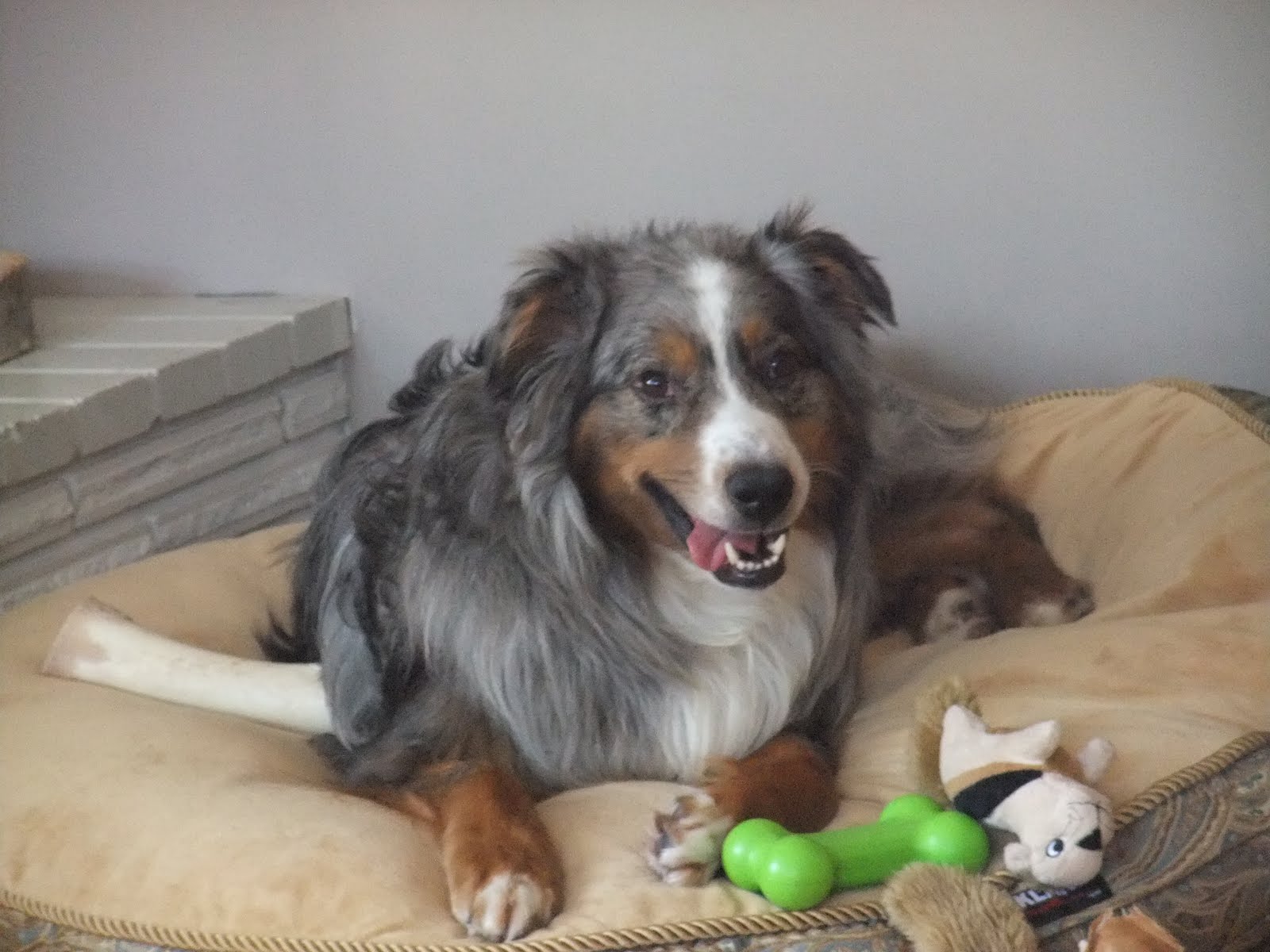
Tank, my 4 year old Australian Shepherd has been suffering from a slight tear in his cruciate ligament. After months of osteopathy and kennel rest it became apparent that he needed surgery to recovery from this injury. After several weeks of preparation (DAP, setting up "stations" around the house for him and getting rid of some excess weight) Tank was ready for his big day. He came through the surgery without cause for concern but we still had an arduous journey ahead of us.

Our wonderful vet, Dr.Barlow from Okotoks Animal Clinic told us bluntly from that start that he was responsible for 30% of the success but the other 70% comes from rest, physio and proper management of his recovery. Tank began 3 months of kennel rest with limited exercise and no contact with our 2 other dogs.

Limited exercise meant that Tank needed to spend his days in an exercise pen or kennel. Thanks to kennel training throughout his life he was able to adjust to this without pause. He has always associated his kennel and pen with a nice bed, good toys and wonderful treats. It also meant that on Tank's short 3 to 5 minute walks he needed to be under control. Of course a formal heel comes into play here. This high energy, happy go lucky dog was no longer getting off leash time so he was a bundle of excitement on walks. We used the formal heel to keep focus on the handler, ignore distractions such as other dogs, squirrels and rabbits as well as to keep him from putting excess pressure on his healing knee.

The work didn't stop there. Tank gets regular cuddle sessions throughout the day to ease his mind and of course keep him happy. The dog can't get enough love to save his life! So Tank began to get "special" treatment. He was allowed to have one on one time on the couch or the bed while I enjoyed a book or tv show. This meant that Tank needed a stay so that he wouldn't jump off the furniture and injure himself. This stay included distractions such as family members coming home, doorbells and strange noises. Luckily Tank has long ago mastered the stay and could safely hang out on the couch or bed without cause for concern.

Never doubt the benefits of obedience training. You never know when you will need these skills in real life. Tank's handle-ability also allowed for x-rays to be taken without him having to be sedated. There are numerous uses for obedience and I can't imagine going through this surgery and recovery without these skills.