Showing posts with label dogs. Show all posts

Monday, April 8, 2013

Changing Spaces

Moving to a new home is stressful for everyone. There’s so much to do and really sometimes our pets don’t get the attention they need to transition smoothly. I recently moved our crew to a new home so I’ve been thinking about this a lot.

All dogs will handle moves differently. Some are laidback and after the first 10 minutes are settled right in. Other dogs can take months to get use to all the changes. If possible take your dog to the new home or neighbourhood before the move to go for a walk and get use to the smells.

Also consider whether you are changing out rules for your dog. For example our new home has a dog run so we’ve gone from allowing the pups to use the yard for their business to asking them to walk across the yard to designated doggy area. This adds to anxiety and stress but can be managed depending on your dog. If your dog has a hard time with change then don't try to do everything all at once.

In addition to rule changes and a complete environment change we also threw out some old furniture and bought a new couch. This does affect the dogs as well so we tried to minimize it by throwing out the old furniture a week before the actual move.


Some things to keep in mind:
  • Continue to exercise your dog and if possible increase your exercise regime
  • Consider using a crate for your dog beforehand and after the move. This gives your dog a space that is his/hers and it doesn’t change. Their dog bed should not be washed right before or after a move. The smells are important to your best friend.
  • Use bones and stuffed kongs to give your dog an activity that helps relieve stress.
  • Monitor your dog for signs of stress that include: off his/her food, loose stool, panting, difficulty in relaxing or settling down
  • Consider using DAP, a thunder shirt, rescue remedy, calming music or even good old lavender to help relieve some anxiety
  • Try to relax yourself. Dogs do pick up on the moods of their owners and may need to be reassured by you. Stay calm, relaxed and take a walk together.

Monday, September 24, 2012

Is your Dog Stressed out?

Even the most well socialized and polite dogs can get stressed out; can you tell when your pooch has had enough? Here are some tips for identifying stress in your dog.
Dogs can become unreasonably stressed out anywhere. You could be at a local festival with people and dogs everywhere or at home where the distant sound of fireworks can send even the most confident canine over the edge. It’s important to be able to identify stress in your dog and help him/her manage it.
Here are a few signs that many dogs will demonstrate:
1. Your dog won’t eat.
This happens all the time. Fido is happily accepting treats from you or strangers and suddenly he’s full. Well your best friend might actually be too uncomfortable to eat. If your dog was previously eating and stops suddenly it’s best to assume he’s upset and take him out of the situation for a well-deserved break.
2. Your dog is no longer able to perform easy obedience cues such as Sit or Shake A Paw.
If your dog knows a cue like Sit then he/she should be able to do it. Dogs will often stop listening to cues when stressed out or over excited. We all know what over excitement looks like so if your pup is just standing stock still and unable to offer a sit then he’s probably had enough.
3. Your dog is offering appeasement signals such as yawning, looking away, lip licking and blinking. He could even be lying down or showing his tummy (not for a belly rub as often mistaken).
Make sure you are familiar with your dog’s language. If you don’t know how to spot calming signals then please take a look at Sarah Kalnajs’ “The Language of Dogs” DVD or Turid Rugaas “Calming Signals” DVD. It’s very important to be able to identify these things.
4. Your dog has frozen still and won’t move.
This one can be difficult as you need to evacuate your dog out of the situation without making him more fearful. I will often use my happy voice and find the path out with the least amount of traffic. You can try using a hand target to get your dog up again but if they’ve frozen it may not work. Depending on the dog you could try gently touching him/her or picking him/her up. Please note that a fearful dog can be dangerous and to keep your own safety in mind. If you watch body language closely you shouldn’t find yourself at this stage.
Remember that it doesn’t matter where you are. If your dog is in distress then please take him/her out of the situation ASAP this includes dog training classes and dog parks. Bites can be prevented with a little bit of knowledge.

Tuesday, September 11, 2012

Why Obedience Training is Integral to Living with Any Dog

My clients literally come into all shapes and sizes. I’ve worked with dogs as small as 4lbs and as large 160lbs. They have varying backgrounds; some are feral dogs from reserves while others were luckier born to breeders who loved them and nurtured them.

The size or breed or even to some degree background doesn’t matter as much as one crucial component that the owner of the dog can control. When I’m addressing a behaviour concern such as aggression, resource guarding or impulse control concerns (such as jumping up or stealing food) it is quicker and easier to “fix” the issues with dogs who have attended some sort of obedience class as a puppy.
Why is this?
Simply put because the dog was socialized to work around distractions (to varying degrees of proficiency) and the owner has a relationship with their dog that includes listening to commands (even if it’s just sit). Dogs who have had no formal training and happen to have an owner who hasn’t taught them much take a lot longer to work with.
So have a new puppy? Time to get to class. Not only are you less likely to have serious behaviour problems down the road but if they do happen it will be easier to address saving you money, stress and time in the long run.
It’s also important to remember that not all obedience classes are created equal. Puppies need to trained using positive reinforcement techniques not coercive or punishment based (no choke chains, no prong collars, no shock collars, no leash corrections using a karate chop or any other sort of hard yank, no hanging in the air, etc). Some of these classes are labeled as positive or balanced training. Puppies specifically should not be trained using harsh corrective methods and even in the “good old days” these methods were not used on dogs under 6 months.
So how do you find a good class? Well there’s a few signs of a great puppy class. You’ll want a trainer who has experience (ask where and if you do not understand the answer look it up as some dog training schools aren’t so good), has certification (CPDT-KA is a good start – that being said there are good trainers out there who do not have certification), use food when training, encourage people to come watch their classes before signing up, and can provide references. Be choosey and don’t settle on someone you don’t like. A good trainer/client relationship can help you keep small problems small throughout your dog’s life.

Friday, August 24, 2012

Traps & Nose Hill Park Calgary

One of my clients forwarded me an email that I thought I should share with as many people as possible. Please note that I have not confirmed any of the details below but just in case it's better to get the word out.

Please note this can be just as dangerous for children as pets. Use caution when walking in the area or avoid it altogether.

Here's the email:

I was walking my dogs up at Nose hill tonight enjoying the evening when I saw a sign about 20 feet to the left off of the pathway. (Shaganappi Entrance - heading east on the pathway).

I begin reading off the sandwich board style sign - printing isn't very big so I approach the sign. The University of Calgary is conducting a "predator study - all dogs must be on leash and remain on the designated pathways". Two of my dogs had run into the trees to find the birds while I was reading. Before I could finish reading one of them is yelping! I run into the trees and realize they are caught in a leg trap!!! (the only good thing about this story is the trap doesn't have teeth - it just has bars that snap closed on the leg)!! A smaller framed dog may end up with a broken leg - or worse - be left as bait for hungry coyotes because the owner cannot find them.There are several (rusty) old traps set up in the same vicinity. A board with spikes or nails is also in there along with two cameras/videos. The boards are likely bait boards with food under them to entice the animal into the right spot for the leg trap to release.

The sign never once indicated any potential harm. The message only states you will face a fine should you not comply with the on-leash rule. Again by the time you read the sign, it may be too late - as I experienced. This is extremely irresponsible with far too many implications considering the amount of people and dogs that frequent the hill. I haven't even touched on the harm and trauma that the various wildlife will face.

I am outraged and shocked that The City and the University have moved forward with this study without warning or providing any details to the public.

I have provided photographs of the leg trap, the board with spikes and two signs.

Please forward this message to those you feel may be affected (people who take their dogs out to Nose hill who's dogs may run into the trees)!

Photos:

Sign #1

Sign #2

Board with Spikes

Leg Trap

Wednesday, January 11, 2012

Sometimes Dogs Don't Get Along...

Alright so I'm running into a common misperception a lot lately... for some reason people think that ALL dogs should get along and be friends or simply work it out until one of them is "in charge" and then life will be peaceful. Sadly this is not the case.

In fact many adult dogs don't get along. They might prefer not to be around puppies, or dislike members of the same sex or feel uncomfortable around larger canines. Whatever their preference some will opt to fight or growl or avoid certain dogs. This is normal and you need to respect your dog's feelings on the matter. This is also why dog parks aren't a great idea for all dogs. It's also a good reason to make sure you allow your dog to meet any potential dogs that you might add to your family beforehand.

If two dogs don't get along and are fighting it is never a good idea to simply "let them work it out". Most fights are all noise and show but if they are allowed to continue it can severely damage any chance of the dogs getting along in the long term. They can also escalate where dogs end up with injuries.

Monday, October 31, 2011

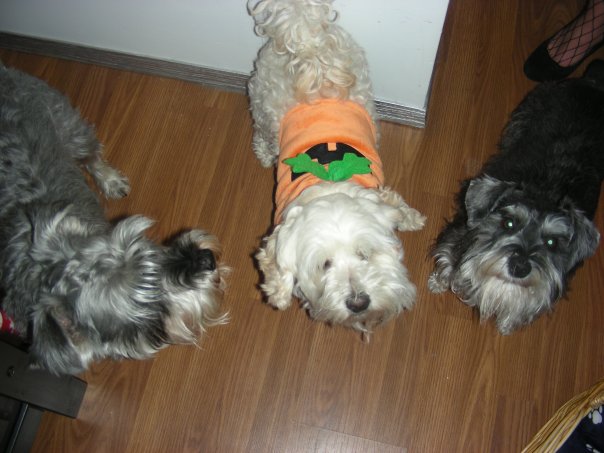
Tips for a Successful Halloween

Halloween is a stressful time for some dog families. If your pooch gets wild every time the doorbell rings then Halloween can really be a nightmare. Here's a few tips to settle down fido. 

#1 - Take your pup out for a lengthy walk before the Trick or Treaters start their night. This will allow your dog to burn some energy beforehand and hopefully lower his/her arousal level. 

#2 - Secure your dog in an area of the house that is away from the door. This will keep the kids and your dog safe. No one wants your pup to accidently end up on the loose! 

#3 - A member of the household should hang out with the dog during the evening and reward all calm behaviour. If your dog is offering a sit or a down then give him/her a treat. Wait for your pooch to repeat the calm behaviour and pay again! Before long your pup might learn that doorbell = lie down. Wouldn't that be great? 

#4 - For dogs with anxiety a spray of Rescue Remedy or DAP might be the answer before the kids start to show up. A thunder shirt can also be useful. 

#5 - Worse case scenerio turn your lights off and spend your evening playing with your pooch. 


Good luck everyone! 

Monday, September 26, 2011

5 Tricks to Teach Any Dog

Not everyone wants a perfectly obedient companion but all dogs need certain essential skills to keep them and the people around them safe. Here's my suggestions for "must haves" in doggy skills:

#5 - Leave It

The all important skill of relinquishing objects or food (or anything else a dog might want to grab). This will help prevent bites, ruined possessions and keep your dog safe from consuming dangerous items left lying around. Luckily leave it as an easy skill to teach and most dogs are quite happy to trade! 

#4 - Stay

Essential for doorways, greeting visitors, a moment when you have to drop your leash, going up and down stairs. Really there's no limit to what stay can do for you. A good, full proofed stay is absolute must have for many dogs and owners. Stay takes some time and effort to teach but is well worth your while. 

#3 - Walking On Leash

A dog that walks well on leash is a dog that gets lots of walks and socialization. Walks are a crucial part of keeping both a dog and owner happy. Teaching your dog not to pull you down the street is something every dog walker can apperciate. 

#2 - Quick Down or Drop command

Having a cue word that immediately stops your dog while running or jumping can help de-escalte any situation where your dog is over excited. This one needs to be taught in small steps. 

#1 - Coming When Called

To me this is the number one skill ANY dog needs. It can be a lifesaver! 

Thursday, September 8, 2011

How Obedience Skills Are Used During Everyday Walks...


Last night I took the crew out for a run around 9pm. We chose a long stretch of grass that allows the dogs to really run and play. The grass is directly beside a road that sees moderate traffic although it was late at night. Our neighbourhood also includes rabbits, cats and the occassional coyote. 

Here's where obedience skills made our walk safe and fun. We saw a cat right after leaving the front door. A simple "watch" cue told my dogs that they should be focused on me instead. We used our loose leash walking skills to make it over to the grass and as a result I wasn't pulled or hauled around. 

Before taking the dogs off leash they were asked for a sit stay. This gives me to do a once over of the area before giving them freedom. It also gives me a chance to practice sit stay (with a real life reward of play for completing the task). 

Once off leash we needed to use "recall" aka "come" a few times when the Aussies went too far. Remember it's dark out so I wanted to make sure I could always see them. They also discovered various pieces of garbage that I didn't need to touch since they all know "leave it" means forever. 

Occassionally when I saw headlights coming it was time for everyone to offer a down stay. This keeps my dogs safely near me and away from traffic. If I had had a beginner dog with me it would have been the perfect chance to practice leash on (and then showing the dog that they can be unleashed again once the car is past which makes putting on the leash a non-issue).  My dogs are taught to hold stay until I release them verbally with an "all done".

The entire walk took about 30-40 minutes. They practiced almost all their basic obedience commands. We didn't use any additional reinforcers (aka food, toys, etc) because I had the best reward available (running free and playing with each other). Remember that obedience is a way of life and not just a class you take when your dog is young. Practice all the time and incorporate it into any activity you do with your dog. Make playing "obedience" the best game and you'll have a dog that can listen anywhere.

Sunday, March 20, 2011

But He Knows This! Why dogs forget training and what to do about it.

All the students have arrived at class and we begin working on a sit stay exercise. The students ask their dogs to sit and then tell them to stay. We wait 10 seconds and then reward and release the dogs. Should be fairly easy for an advanced class right? Well not always. Sometimes a dog just doesn’t stay or worse yet seems to have forgotten what sit means! So what’s happening? 

A couple of different scenarios might be going on. My first guess would be that the dog isn’t motivated. Clearly he/she knows what sit means and probably at this point what stay means but is choosing not to perform the expected behaviour. It doesn’t mean the dog has forgotten the commands. Pamela Reid Ph.D. explains this as learning/performance distinction. She states that a “whether or not a behaviour is performed depends on a lot of things: opportunity, motivation, physical abilities, and learning”1. This means that just because a dog doesn’t do what he/she is told doesn’t mean that he/she doesn’t know how to do it. 

A crucial part of training is maintaining a behaviour/command. This means you have to practice, use reinforcers that matter to your dog at that moment in time and you back up any command with getting the desired behaviour. All too often owners expect the dogs to hear sit, sit, sit all day long without reinforcement (or even actually getting the dog to sit at all) which tells the dog that this command doesn’t matter. 

Performing a Sit Stay in class:
  • Have you given your dog a chance to respond before double commanding, asking for a sit before you have focus or physically putting your dog in a sit ?
  • Why should your dog sit/stay? What’s in it for them? And don’t say because he/she loves me.
  • Is my dog injured, sick or anxious? I found out that my dog Tank stopped sitting because of a knee injury, good thing I didn’t jump into punishment mode on him!
  • Have I taught my dog how to sit and stay in this environment? Should I go back a few steps?
The same thing can happen with house training. It snows out and the dog suddenly starts peeing in the house. The dog is no longer motivated to go outside since most owners stop rewarding house training fairly quickly by sending their dog outside alone and further more we add some unpleasant conditions .The rug starts to look like an ideal bathroom. Now what do you do? Go back to the basics and head outside with your dog. Occasionally reward them for going outside with praise, petting, treats or games. This will provide the motivation for your dog to go outside (even in the cold), do their business and keep you happy. 

Performing Eliminating Outside:
  • Has your dog had the opportunity to go out regularly or did you leave it too long?
  • Is your dog motivated to go to the bathroom outside or have you completely stopped rewarding it?
  • Is your dog sick?My dog Heidi started peeing in her sleep and we discovered it was from a hormone imbalance. Once she was on Estrogen she no longer peed inside.
  • Have you properly trained your dog where to go to the bathroom? Confusion ensues if you switch between indoor bathroom areas/outdoor bathroom areas?
So you can see how regression occurs and why dogs sometimes don’t perform behaviours we previously thought were rock solid. This happens to everyone! Don’t get upset just take a breath and ask yourself why this might be happening? Go through whether you gave the dog the right opportunities to do what you want, is your dog motivated or physically unable to do what you want and have you trained/maintained your dog to continue to do this behaviour?

1 Reid, Pamela J. Ph.D., Excel-erated Learning: Explaining how dogs learn and how best to teach them. James & Kenneth Publishers, 1996. 

Wednesday, November 17, 2010

The Best Dog Coats

Well winter has hit and it's time for many dogs to bundle up when going outside. Both my Aussies are fine in just their heavy fur coats but my terriers are another story...

For years Russ and Heidi have been sporting Greenhawk Dog Blankets. I bought theirs a few years and they last! Russ has had the same coat for 5 years now and Heidi if she hadn't changed weights would have been in a similar situation. 


They've added some new styles over time yet this coat remains a great deal! They retail for around $30cnd and are built to last! Visit their store in SE Calgary or check out the website: www.greenhawk.net 

The coats come in a variety of colours, sizes and weights. Dog coats are needed for some of our lighter coated dogs such as terriers, pointers, most lap dogs and short coated herding breeds. Don't let your dog be cold this winter when he/she could be enjoying themselves outside.

Both Russ & Heidi give these jackets 2 paws up!

Thursday, October 7, 2010

More Pets Than People...

Managing a multi-pet home can be challenging and I can definitely relate. I share my home with at minimum 3 dogs at a time and generally we will have an extra dog and one or two cats hanging around too. Here's some practical tips on how to live in harmony when the pets outnumber the people... 

The most important first step is making each and every single dog has attended at least 1 obedience class. This allows you to bond one on one with your dog without the other pets competing for attention. It also allows you to create a basic foundation of training with your pet. All dogs should learn their name, sit, down, stay, how to walk on leash and recall. A good obedience class will give you those foundation skills in a rather short order. 

It's also important to realize that training is a lifelong process for dogs. My own dogs attend classes regularly to enhance our bond, practice new skills in a distracting setting and to enjoy dog sports. If you're not a training addict like me that's alright but remember you will still need to spend time polishing your basic skills with each dog individually. 

Karen London, PhD and Patricia McConnell, PhD also recommend giving your dogs a "group" name. This allows you to address your dogs all at once if need be. This comes in handy when you're at the park and need everyone to come at once. It can also be helpful when your dogs start to misbehave and you want their attention. A group name can be something as simple as "puppies" or "kids". I use "aussies" to address my boys. Heidi is rarely in on the action with them and generally just needs her individual name. 

Remember when dealing with a home with dogs of a different breeds, ages, sizes, genders that the rules for one dog might not be the same for another. That's alright! My pint size Schnauzer is definitely allowed to do things that my 60lb Aussies are not.  My puppy also has different rules than my trustworthy adult dogs and that's alright too. He'll have his chance to earn the same privileges. My puppy tends to get more training time and exercise time to make up for his extra rules. Life isn't always fair and that's alright! 

If you're experiencing any aggression type issue with multiple dogs in the house make sure to contact a qualified positive reinforcement trainer to give you some guidance.