My Aussie Marco is a really friendly and well adjusted dog. He came to me with a great temperament at 8 weeks old and through mountains of socialization he has continued to be my most trustworthy dog around other dogs, small animals, babies and of course new people. Marco however has a secret... he use to be extremely barrier reactive. What does this mean?
Barrier reactivity is when you put a dog behind a fence, kennel door, window, leash, etc. and they see a person or another dog or small animal. An over reaction follows that might include lunging, growling, showing of teeth, barking, snarling, etc. Marco literally went from wiggling, happy puppy to full on vampire face. Even my trainer friends thought he was aggressive until of course I opened the kennel door and poof it vanished and my happy boy was back.
Marco had a very specific form of barrier reactivity that occurred only when he was in his kennel and saw another dog. It also had to be a dog he didn't know well (the other dogs in my house didn't elicit any sort of reaction from him). I deduced that for Marco it occurred because he was extremely frustrated that he couldn't go meet the other dogs and he would blow up like a toddler having a temper tantrum until he got his way and was allowed to play. This behaviour first appeared at 6 months (right around when adolescence kicks in) and I had solved the problem before he reached 8 months. It did take some work though.
So now that you have a good idea of what barrier reactivity is you're probably wondering how you can solve it? Well it depends on WHY your dog is reacting. A good trainer can help you figure this one out. A dog that is overly excited is different than a dog that is fearful. Both dogs can demonstrate barrier reactivity. I would address the issues quite differently though. An over excited dog needs to learn impulse control (Marco had to wait to be quiet before I would let him out of the kennel to play so he learned quiet, calm behaviour got him what he wanted instead of growling). A scared dog (like Heidi) needed a confidence boosting program to help her learn to trust not only me but understand that people passing by aren't going to hurt her.
The good news is that barrier reactivity is one of those issues that can be resolved within a fairly reasonable amount of time and improve the dog's (and owner's) quality of life fairly significantly.
Where's Your Sit? offers 2 fun group classes that can help both hyper, excited dogs as well as fearful dogs. Check out our Hyper Dog Program or our Confidence Booster Program to help your pup today. We also offer private, in home training that can address this issue.

Where’s Your Sit offers professional, in-home pet dog training services for puppies and adult dogs, and indoor/outdoor dog training classes. We serve Calgary, Alberta and surrounding areas.
Showing posts with label pulling on leash. Show all posts
Showing posts with label pulling on leash. Show all posts
Wednesday, December 28, 2011


Tuesday, July 26, 2011
Why Does My Dog Go Crazy On Leash?
Increasingly pet owners are complaining about dogs that seem to go crazy on leash when they see other dogs, people or wildlife but are fine off leash. So what's going on?
Dogs are inherently social creatures and like to investigate their world. When off leash they can determine how to approach (distance, speed, posture, if to approach at all, etc) but we add a leash to the situation and suddenly the dog has no choices at all. Add in the fact that very few humans that are aware of dog body language and social behaviour and there's disaster. Scared dogs learn that they are forced to interact with unknowns in their environment in an unpleasant way. Hyper/friendly dogs learn that they can't get access to exciting stimuli and become frustrated.
And then leash reactivity happens. That's the behaviour where a dog is at the end of his/her leash barking/lunging/growling, etc or running around in circles with the same results. Most of the time the owners are really embarrassed and don't know what to do.
This is definitely the time to call in a positive reinforcement trainer to help you come up with a plan. Fearful dogs will need different protocols than hyper/friendly dogs. A good dog trainer can spot the difference where most people can't. Sometimes a very scared dog looks hyper or aggressive. You won't get anywhere if you can't tell the difference.
Many training academies will offer special classes for dogs with these issues but I highly recommend you start with private one on one training. A lot of the work can start right in the home.
My own Miniature Schnauzer Heidi came to me as a fearful reactive dog. She would bark and have a fit at anything that moved (people, dogs, cats, birds, bikes, skateboards, leaves, etc). You wouldn't know it today. We worked slowly on desensitizing her to each environmental fear (and I mean slowly as it took well over a year) and at the same time participated in confidence building activities and fine tuned her obedience skills. Heidi now helps me work with other fearful reactive dogs as she can be a relaxing prescence. That's success! Help is out there and the longer you wait the worse it tends to get.

Dogs are inherently social creatures and like to investigate their world. When off leash they can determine how to approach (distance, speed, posture, if to approach at all, etc) but we add a leash to the situation and suddenly the dog has no choices at all. Add in the fact that very few humans that are aware of dog body language and social behaviour and there's disaster. Scared dogs learn that they are forced to interact with unknowns in their environment in an unpleasant way. Hyper/friendly dogs learn that they can't get access to exciting stimuli and become frustrated.
And then leash reactivity happens. That's the behaviour where a dog is at the end of his/her leash barking/lunging/growling, etc or running around in circles with the same results. Most of the time the owners are really embarrassed and don't know what to do.
This is definitely the time to call in a positive reinforcement trainer to help you come up with a plan. Fearful dogs will need different protocols than hyper/friendly dogs. A good dog trainer can spot the difference where most people can't. Sometimes a very scared dog looks hyper or aggressive. You won't get anywhere if you can't tell the difference.
Many training academies will offer special classes for dogs with these issues but I highly recommend you start with private one on one training. A lot of the work can start right in the home.
My own Miniature Schnauzer Heidi came to me as a fearful reactive dog. She would bark and have a fit at anything that moved (people, dogs, cats, birds, bikes, skateboards, leaves, etc). You wouldn't know it today. We worked slowly on desensitizing her to each environmental fear (and I mean slowly as it took well over a year) and at the same time participated in confidence building activities and fine tuned her obedience skills. Heidi now helps me work with other fearful reactive dogs as she can be a relaxing prescence. That's success! Help is out there and the longer you wait the worse it tends to get.

Saturday, January 1, 2011
One of my Favourite Training Tools
Since Loose Leash Walking seems to be a major struggle for most dog owners I wanted to take some time and introduce one of my favourite dog walking products: the Gentle Leader. It's fairly well known but I still come across quite a number of frustrated owners who haven't heard of it.
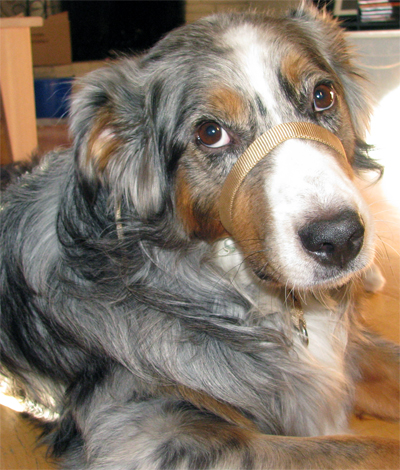
The Gentle Leader works in a similar way to a horse halter/head collar. It fits over the mouth and snaps behind the ears. Dogs can eat, drink and play with it on. It does get mistaken for a muzzle sometimes but don't be fooled; dogs can definitely still bite with it on!

The purpose of the Gentle Leader is to take away the dog's ability to pull. Although no training tool will solve pulling all by itself this one comes the closest. In my opinion it works better than harnesses, choke collars, shock collars or prong collars and is of course humane. I find it works best for medium to large breed dogs such as Australian Shepherds, Labradors, Malamutes, etc. For the smaller dogs I generally recommend a Sensation Harness or an Easy Walk Harness but you can use Gentle Leaders on the small ones too.
The down side to head collars in general is that some dogs simply don't like to wear them (picture your puppy at 8 weeks with his/her first collar and they flail around). You need to start off slow by putting it on, feeding a few treats and then taking it off right away. I recommend doing this a few times and leaving it on just a bit longer each time. After a few days try a walk.
Another thing to keep in mind is that if you have previously used a type of correction collar: martingale, prong or choke chain then you need to be very careful about not "correcting" with the Gentle Leader. You don't want to throw your dog's spine out of wack and it's not meant to be jerked about in a harmful manner. On the bright side if you have damaged your dog's throat by using a correction collar than a Gentle Leader will be safer and more comfortable for your dog to wear.
I've used a Gentle Leader for 3 out of 4 of my own dogs: Russ, Tank and Marco while training them to walk on leash. Tank still likes to wear his. Make sure to combine a Gentle Leader with training (using treats to reinforce heel position, direction changes to keep your dog interested and not moving forward when he/she pulls).

Subscribe to:
Posts (Atom)